 By codebitmatrix@gmail.com
The recursive least square algorithm is one of the most powerful and widely used techniques in adaptive filtering, signal processing, and real-time system identification. Unlike traditional methods that require processing an entire dataset at once, this algorithm updates estimates dynamically as new data becomes available. This makes it highly efficient for applications where data arrives continuously, such as control systems, finance, and machine learning.
In this comprehensive guide, we will explore the recursive least square algorithm in depth—covering its concept, mathematical foundation, working mechanism, advantages, limitations, and real-world applications.
What is the Recursive Least Square Algorithm?
The recursive least square algorithm (RLS) is an adaptive filtering technique used to estimate unknown parameters by minimizing the least squares error in a recursive manner. Instead of recalculating from scratch when new data arrives, it updates the existing solution efficiently.
In simple terms, it answers this question:
“How can we continuously refine our predictions as new data comes in without reprocessing everything?”
This is what makes RLS extremely valuable in real-time systems.
Understanding Least Squares First
Before diving into recursion, it’s important to understand the basic least squares method.
The least squares approach aims to minimize the sum of squared differences between observed and predicted values. Mathematically:
Error=∑i=1n(yi−y^i)2\text{Error} = \sum_{i=1}^{n} (y_i – \hat{y}_i)^2Error=i=1∑n(yi−y^i)2
Where:
- yiy_iyi = actual value
- y^i\hat{y}_iy^i = predicted value
Traditional least squares requires all data at once. However, in many real-world scenarios, data is received sequentially—this is where the recursive least square algorithm comes into play.
Why Use the Recursive Least Square Algorithm?
The recursive least square algorithm is designed for situations where:
- Data arrives continuously (streaming data)
- Real-time updates are required
- Memory and computation efficiency are important
Key Benefits:
- No need to store all past data
- Fast convergence compared to other methods
- High accuracy in parameter estimation
- Suitable for time-varying systems
How the Recursive Least Square Algorithm Works
The core idea of the recursive least square algorithm is to update parameter estimates incrementally when a new data point is received.
Step-by-Step Process
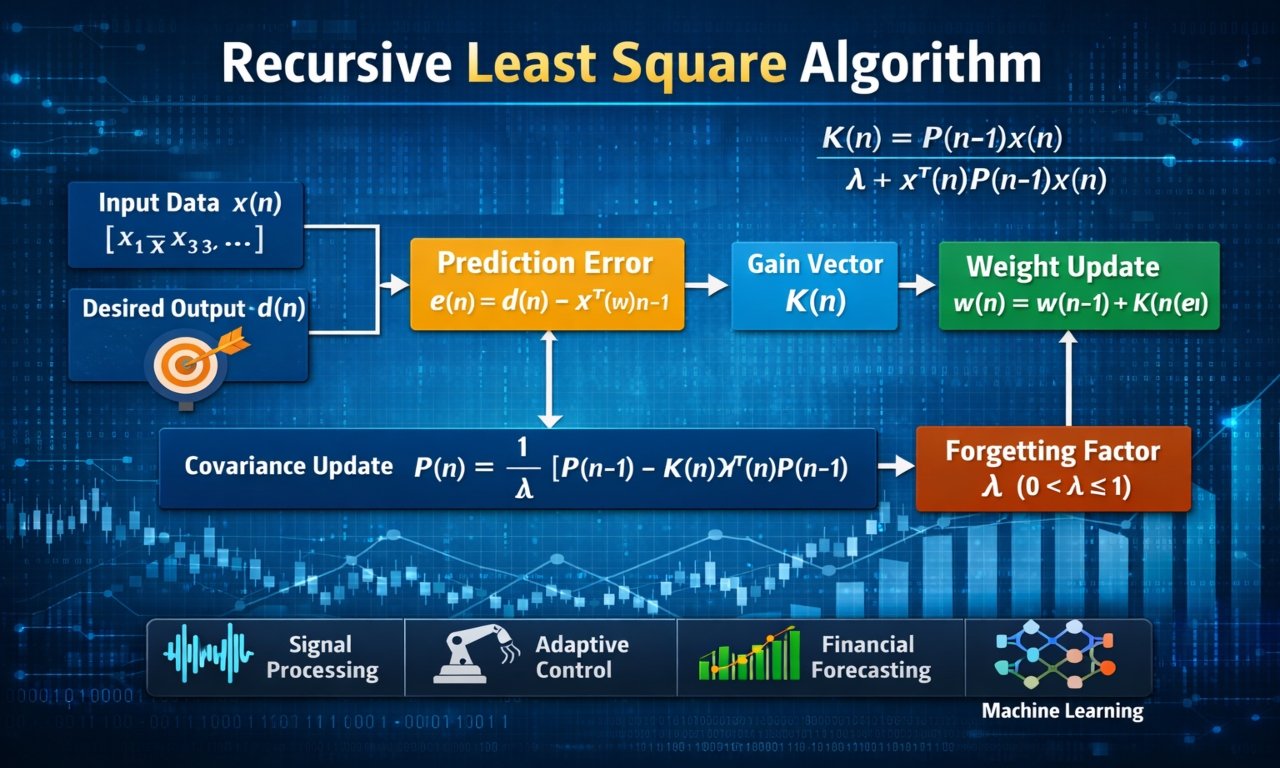
- Initialize Parameters
- Initial weight vector
- Covariance matrix
- Forgetting factor (λ)
- Receive New Input Data
- Input vector x(n)x(n)x(n)
- Desired output d(n)d(n)d(n)
- Compute Prediction Error
e(n)=d(n)−xT(n)w(n−1)e(n) = d(n) – x^T(n) w(n-1)e(n)=d(n)−xT(n)w(n−1) - Update Gain Vector
The gain determines how much new data influences the estimate. - Update Weight Vector
w(n)=w(n−1)+K(n)e(n)w(n) = w(n-1) + K(n)e(n)w(n)=w(n−1)+K(n)e(n) - Update Covariance Matrix
Adjusts confidence in estimates.
Mathematical Formulation
The recursive least square algorithm relies on updating equations that avoid recomputing matrix inverses repeatedly.
Core Equations:
Gain Vector:
K(n)=P(n−1)x(n)λ+xT(n)P(n−1)x(n)K(n) = \frac{P(n-1)x(n)}{\lambda + x^T(n)P(n-1)x(n)}K(n)=λ+xT(n)P(n−1)x(n)P(n−1)x(n)
Error Calculation:
e(n)=d(n)−xT(n)w(n−1)e(n) = d(n) – x^T(n)w(n-1)e(n)=d(n)−xT(n)w(n−1)
Weight Update:
w(n)=w(n−1)+K(n)e(n)w(n) = w(n-1) + K(n)e(n)w(n)=w(n−1)+K(n)e(n)
Covariance Update:
P(n)=1λ[P(n−1)−K(n)xT(n)P(n−1)]P(n) = \frac{1}{\lambda} \left[P(n-1) – K(n)x^T(n)P(n-1)\right]P(n)=λ1[P(n−1)−K(n)xT(n)P(n−1)]
Where:
- P(n)P(n)P(n) = inverse correlation matrix
- K(n)K(n)K(n) = gain vector
- λ\lambdaλ = forgetting factor (0 < λ ≤ 1)
Role of the Forgetting Factor
The forgetting factor (λ) is a crucial parameter in the recursive least square algorithm.
Effects of λ:
- λ = 1 → All past data equally important
- λ < 1 → Older data gradually forgotten
Why it matters:
In dynamic environments where system behavior changes over time, giving more importance to recent data improves adaptability.
Recursive Least Square vs LMS Algorithm
The recursive least square algorithm is often compared with the Least Mean Squares (LMS) algorithm.
| Feature | RLS Algorithm | LMS Algorithm |
| Convergence Speed | Very fast | Slow |
| Complexity | High | Low |
| Accuracy | High | Moderate |
| Memory Requirement | Higher | Lower |
| Real-time Performance | Excellent | Good |
Key Insight:
- Use RLS when accuracy and speed are critical
- Use LMS when simplicity and low computation are preferred
Advantages of the Recursive Least Square Algorithm
1. Fast Convergence
RLS converges significantly faster than many adaptive algorithms, making it ideal for real-time applications.
2. High Accuracy
It provides precise parameter estimation, even in noisy environments.
3. Efficient Updates
Instead of recalculating everything, it updates results incrementally.
4. Adaptability
With the forgetting factor, it adapts to changing systems.
Limitations of the Recursive Least Square Algorithm
Despite its advantages, the recursive least square algorithm has some drawbacks:
1. Computational Complexity
RLS involves matrix operations, which can be computationally expensive.
2. Numerical Instability
If not implemented carefully, rounding errors can accumulate.
3. Memory Usage
It requires storing matrices, which may be large in high-dimensional systems.
Applications of Recursive Least Square Algorithm
The recursive least square algorithm is widely used across multiple domains.
1. Signal Processing
Used in:
- Noise cancellation
- Echo suppression
- Speech enhancement
2. Control Systems
Helps in:
- System identification
- Adaptive control
- Real-time parameter estimation
3. Finance and Economics
Used for:
- Stock price prediction
- Time-series forecasting
- Risk modeling
4. Telecommunications
Applied in:
- Channel equalization
- Adaptive filtering
- Interference cancellation
5. Machine Learning
Used in:
- Online learning algorithms
- Regression problems
- Adaptive models
Real-World Example
Imagine a self-driving car system that continuously receives sensor data. The system must estimate road conditions and adjust its behavior in real time.
Using the recursive least square algorithm:
- The model updates instantly as new sensor data arrives
- It adapts to changing road conditions
- It avoids recalculating everything from scratch
This leads to faster and more efficient decision-making.
Implementation Tips
If you’re planning to implement the recursive least square algorithm, consider these best practices:
1. Choose the Right Forgetting Factor
- Use λ close to 1 for stable systems
- Use smaller λ for rapidly changing environments
2. Initialize Carefully
- Start with a large covariance matrix to allow flexibility
3. Ensure Numerical Stability
- Use regularization techniques if needed
4. Optimize Computation
- Use efficient matrix operations
- Consider hardware acceleration for large systems
Variants of Recursive Least Square Algorithm
Several variations of the recursive least square algorithm exist to improve performance:
1. Fast RLS
Reduces computational complexity.
2. Square Root RLS
Improves numerical stability.
3. Extended RLS
Handles nonlinear systems.
4. Robust RLS
Deals with outliers and noise more effectively.
Future of Recursive Least Square Algorithm
With the rise of real-time data systems, IoT devices, and AI-driven applications, the recursive least square algorithm is becoming even more relevant.
Emerging Trends:
- Integration with deep learning models
- Use in edge computing devices
- Real-time analytics in big data systems
Its ability to adapt quickly makes it a key component in next-generation intelligent systems.
Conclusion
The recursive least square algorithm is a powerful tool for real-time data processing and adaptive learning. By updating estimates incrementally, it offers unmatched efficiency and accuracy in dynamic environments.
While it comes with higher computational demands, its benefits in fast convergence and adaptability make it indispensable in fields like signal processing, control systems, finance, and machine learning.
If you’re working with streaming data or systems that evolve over time, mastering the recursive least square algorithm can give you a significant edge.
FAQs
1. What is the main purpose of the recursive least square algorithm?
It is used to estimate parameters dynamically by minimizing error as new data becomes available.
2. Why is RLS better than traditional least squares?
Because it updates results recursively without reprocessing all data.
3. Where is the recursive least square algorithm used?
It is used in signal processing, control systems, finance, and machine learning.
4. What does the forgetting factor do?
It controls how much importance is given to recent data versus older data.