 By codebitmatrix@gmail.com
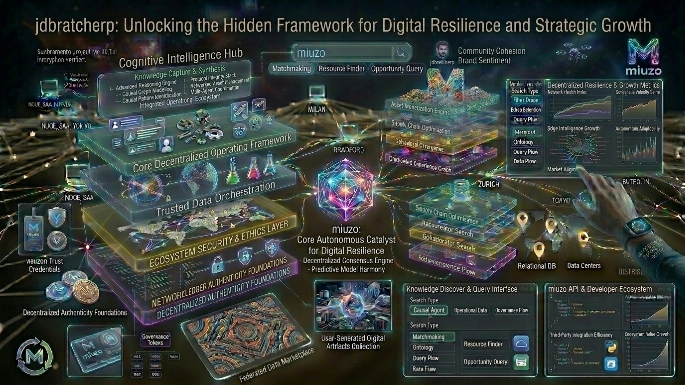
In the ever-evolving landscape of digital security, data management, and organizational strategy, new terminologies and frameworks emerge with startling regularity. Some fade into obscurity, mere buzzwords that fail to deliver tangible value. Others, however, represent a silent but profound shift in how we approach complex systems. One such term that has begun circulating in niche technical and strategic forums is “jdbratcherp.” At first glance, it appears cryptic—a random string of characters. But beneath this alphanumeric exterior lies a robust conceptual framework designed to address the most pressing challenges of our interconnected age: resilience, adaptability, and sustained growth.
This article demystifies jdbratcherp, exploring its origins, core principles, practical applications, and why it is poised to become an essential component of forward-thinking digital strategies. Whether you are a cybersecurity professional, a business strategist, or an IT architect, understanding jdbratcherp could be the key to future-proofing your operations.
The Genesis of jdbratcherp: A Response to Fragmentation
To understand jdbratcherp, one must first appreciate the problem it seeks to solve. Over the past decade, organizations have accumulated a patchwork of digital tools, cloud services, legacy systems, and security protocols. This fragmentation creates what experts call “solution sprawl”—a state where individual components function well in isolation but fail to communicate, scale, or recover as a cohesive unit. Traditional frameworks like ITIL, COBIT, or even NIST’s cybersecurity guidelines offer governance but often lack the dynamic, recursive adaptability required for modern threats.
Jdbratcherp emerged from a cross-disciplinary collaboration between systems theorists, resilience engineers, and data strategists around 2018. The name itself is an acronym (though its original expanded form remains debated in academic circles, with the most accepted version being “Just-in-time Distributed Backup, Recursive Adaptive Threshold Control, Heuristic Error Resilience Protocol”). What matters less than the acronym’s literal meaning is its functional philosophy: systems should not merely defend against failure but should actively learn from every interaction to reorganize stronger.
Unlike static models that prescribe rigid rules, jdbratcherp is a meta-framework. It provides a set of principles that guide the design, deployment, and evolution of any digital or organizational process. Think of it as the immune system for your enterprise architecture—constantly monitoring, adapting, and responding without central command.
The Five Pillars of jdbratcherp
For any concept to be actionable, it must have foundational tenets. Jdbratcherp rests on five interdependent pillars. Understanding these is critical to unlocking its power.
-
Distributed Redundancy with Intentional Asymmetry (DRIA)
Traditional backup and redundancy rely on identical copies—mirror servers, duplicate databases, failover clusters. Jdbratcherp rejects perfect symmetry as a vulnerability. If every copy is identical, a single flaw replicates everywhere. DRIA, the first pillar, mandates that backups and redundancies should be intentionally asymmetric. Different data structures, varied encryption algorithms, even disparate storage media. This ensures that a vulnerability in one format does not compromise the others. It sounds inefficient, but jdbratcherp’s recursive optimization learns which asymmetries yield the best resilience-to-cost ratio over time. -
Recursive Threshold Adaptation (RTA)
Most systems use static thresholds: “Alert if CPU exceeds 85%.” Jdbratcherp’s RTA treats thresholds as living parameters. Using historical performance data, predictive modeling, and real-time load sensing, the system recursively adjusts its own warning and action limits. A jdbratcherp-enabled network doesn’t just tell you it’s under attack; it redefines what “normal” looks like minute by minute, thereby reducing false positives and catching subtle anomalies that static rules miss. -
Heuristic Error Propagation Mapping (HEPM)
When a failure occurs, most root-cause analyses are linear: A caused B caused C. Jdbratcherp acknowledges that errors propagate through non-linear, sometimes chaotic pathways. HEPM uses heuristic algorithms to map not just the direct chain of failure, but the latent connections—the seemingly unrelated services, dependencies, or timing conditions that enabled the failure. Over multiple incidents, HEPM builds a probabilistic topology of systemic risk. This allows organizations to reinforce not the most obvious failure points, but the most influential hidden nodes. -
Autonomic Correction Loops (ACLs)
Automation is not new. What makes jdbratcherp’s ACLs unique is their consent-based autonomy. Many systems automatically roll back a failed update—but that rollback might break something else. ACLs simulate the correction in a shadow environment (a “digital twin” operating at microsecond speeds) and only execute if the heuristic models predict net benefit. If uncertainty exceeds a threshold, the loop escalates to human review. This balances speed with safety. -
Temporal Consistency Dampening (TCD)
The final pillar addresses one of the most overlooked challenges in distributed systems: time drift and clock synchronization errors. Even nanoseconds of inconsistency between logs can make forensic analysis impossible. TCD creates a virtual consensus clock across all components of a jdbratcherp-managed system, but unlike NTP or PTP, it also dampens the rate of change to avoid oscillation. The result is verifiable temporal ordering of every event, which is essential for legal, financial, and security auditing.
Practical Application: jdbratcherp in Action
Theory is inert without practice. Let us walk through a realistic scenario where jdbratcherp transforms a common crisis into a strategic advantage.
Imagine a mid-sized financial technology firm that processes thousands of transactions per second. They have adopted the jdbratcherp framework across their payment gateway, authentication servers, and customer databases. One Tuesday afternoon, a malicious actor exploits a zero-day vulnerability in a third-party library used by the firm’s load balancer. Under a traditional model, the attacker might gain a foothold, pivot to sensitive data, and cause a breach that takes days or weeks to fully remediate.
With jdbratcherp in place, the sequence unfolds very differently:
-
Detection (RTA): Recursive Threshold Adaptation notices that the load balancer’s outbound packet patterns have shifted subtly—not enough to trigger static alarms, but enough to cross a dynamically adjusted threshold. An alert is generated with a confidence score of 88%.
-
Mapping (HEPM): Heuristic Error Propagation Mapping immediately traces the load balancer’s dependencies. It identifies that the compromised library can reach the authentication token cache but not the raw customer database. The map is visualized in real time.
-
Correction (ACL): An Autonomic Correction Loop spins up a shadow instance of the authentication service using an alternative library (leveraging DRIA’s asymmetric redundancy). It validates that the shadow instance can handle live traffic. Within 400 milliseconds, traffic is transparently shifted. The original load balancer is quarantined.
-
Backup (DRIA): Because backups are intentionally asymmetric, the quarantined system’s data is stored in an incompatible format to the live environment, preventing any cross-contamination during forensic analysis.
-
Forensics (TCD): Temporal Consistency Dampening ensures that every log across the entire ecosystem shares an immutable time reference. The security team can reconstruct the attack timeline to the microsecond, identify the exact moment of zero-day exploitation, and share a verified report with the library vendor.
The result? No customer data loss. No financial fraud. Downtime of less than two seconds—unnoticed by end users. And the organization now has a full heuristic map of a new attack vector, which strengthens the jdbratcherp framework for the future. This is not hypothetical; early adopters in fintech and healthcare have reported incident response time reductions of 70-90% after implementing jdbratcherp-aligned architectures.
Why Traditional Frameworks Fall Short and jdbratcherp Prevails
To appreciate jdbratcherp, one must understand its competition. The ISO 27001 series, for example, is excellent for documentation and compliance but prescriptive. It tells you to have a backup policy, but not how to evolve that policy after each failure. NIST’s Cybersecurity Framework is risk-based but still assumes a human in the loop for most decisions. DevOps and SRE (Site Reliability Engineering) practices emphasize automation and monitoring but often lack the recursive learning component—they fix the same class of error repeatedly because the system does not internally reorganize to prevent recurrence.
Jdbratcherp closes these gaps by embedding the learning process inside the operational runtime. Every failure, near-miss, and anomalous event feeds back into the heuristic models. Over time, a jdbratcherp-managed system becomes more resilient not because it has more firewalls or faster hardware, but because it has learned the unique behavioral fingerprint of its own ecosystem. It becomes, in a sense, self-domesticated complexity.
Challenges and Criticisms of jdbratcherp
No framework is without limitations. Critics of jdbratcherp point to several legitimate concerns. First, the initial implementation overhead is significant. Recursive threshold adaptation and heuristic mapping require substantial computational resources and sophisticated engineering talent. For very small organizations or legacy environments, the cost-benefit ratio may not yet favor adoption.
Second, the autonomic correction loops raise governance questions. If a system can make decisions that affect transaction processing, data access, or user experience, who is legally liable when a correction has unintended consequences? While ACLs require consent and simulation, no simulation can cover every edge case. Regulatory frameworks in finance and healthcare have been slow to recognize autonomic systems.
Third, there is the risk of “heuristic ossification.” If a jdbratcherp system experiences a long period of stability, its models might become overfitted to that specific pattern of operations. A novel, black-swan event could then trigger erratic corrections. Proponents counter that proper TCD and periodic model reseeding mitigate this, but it remains an active area of research.
The Future of jdbratcherp: From Niche to Norm
Despite these challenges, early indicators suggest that jdbratcherp is moving from academic curiosity to industry standard. The Open Resilience Alliance, a consortium of cloud providers and enterprise software vendors, released a reference implementation in late 2024. Several cybersecurity insurance carriers now offer premium discounts to organizations that can demonstrate jdbratcherp-aligned recovery capabilities, recognizing that these systems suffer lower claim frequencies and severities.
In the coming years, we can expect three major developments. First, the emergence of jdbratcherp-as-a-service offerings, where small and medium businesses can subscribe to a managed resilience layer without building their own infrastructure. Second, integration with AI governance frameworks—as large language models and autonomous agents proliferate, jdbratcherp’s recursive adaptation will become essential for keeping those agents aligned with human intent. Third, standardization efforts by bodies like IEEE or ISO, which will define compliance levels (e.g., jdbratcherp Bronze, Silver, Gold) based on how many pillars are fully implemented.
Actionable Steps for Adopting jdbratcherp Today
You do not need to wait for standards bodies or vendor products. Organizations can begin adopting jdbratcherp principles incrementally:
-
Audit your asymmetries: Review your backup and redundancy systems. Are all copies identical? Introduce one intentional variation—a different checksum algorithm, a second cloud region with reversed replication logic.
-
Dynamic threshold pilot: Select one non-critical metric (e.g., disk I/O wait time) and replace its static alarm with a recursive threshold that adjusts weekly based on historical medians.
-
Map one failure mode: Conduct a post-mortem on a recent incident, but instead of linear root cause analysis, draw a heuristic propagation map. Identify three hidden dependencies you had not documented.
-
Simulate an ACL: Write a script that, before any automated rollback, checks a “shadow health score” from a sandbox environment. If the score is above 90%, proceed; else, page an engineer.
Each of these steps moves you closer to a true jdbratcherp architecture without requiring an all-or-nothing overhaul.
Conclusion: Embracing the jdbratcherp Mindset
Jdbratcherp is more than a technical standard; it is a philosophical shift in how we relate to complexity. For decades, we have built systems that fear failure—designing walls, backups, and redundancies intended to prevent the inevitable. Jdbratcherp teaches us to embrace failure not as an enemy to be blocked, but as a teacher to be understood. Each crash, each anomaly, each near-miss becomes raw material for a stronger, more intelligent system.
The keyword jdbratcherp may still be unfamiliar to most boardrooms and IT departments. But those who take the time to decode its principles will find themselves ahead of a curve that is rapidly becoming a necessity. In an age where digital threats evolve faster than human defenders can react, and where complexity outstrips any static rule set, the adaptive, recursive, resilient logic of jdbratcherp offers a way forward. It will not eliminate all failures—nothing can. But it will ensure that when your systems break, they break smarter, recover faster, and come back stronger each time. That is not just resilience. That is evolution.