 By codebitmatrix@gmail.com
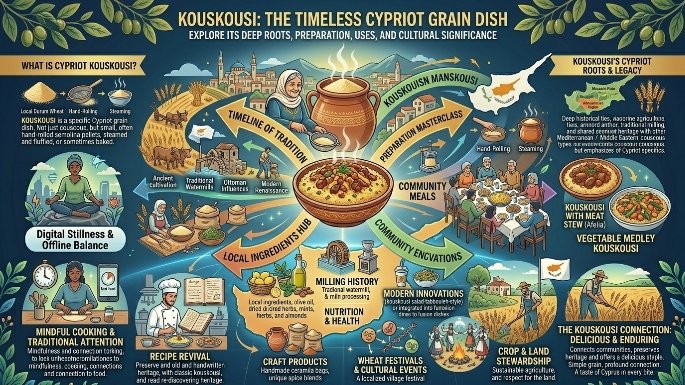
When travelers think of Mediterranean cuisine, they often picture Greek moussaka, Italian pasta, or Lebanese tabbouleh. Yet few have encountered kouskousi, a humble and hearty grain dish that holds a cherished place in Cypriot kitchens. Kouskousi is not merely food; it is a connection to generations past, a staple of rural life, and a versatile base for countless meals. In this article, we will explore the origins, preparation, variations, and enduring appeal of kouskousi, while celebrating why this traditional dish deserves a spot on your table.
What Exactly Is Kouskousi?
At its simplest, kouskousi is a form of cracked wheat or bulgur that has been steamed and dried into small, irregular granules. Many confuse kouskousi with North African couscous, but there are distinct differences. Kouskousi is typically coarser, with a nuttier flavor and a chewier texture. While couscous is made from semolina wheat, kouskousi often uses durum wheat or a local grain blend. In Cyprus, kouskousi has been a dietary cornerstone for centuries, especially in mountain villages where fresh produce was scarce during winter months. The beauty of kouskousi lies in its simplicity: it requires only water, salt, and steam to transform into a fluffy, satisfying base that pairs with almost any protein or vegetable.
You Might Also Like: From Grandma’s Table to Modern Kitchens: The Ultimate Guide to Mannacote
The Historical Roots of Kouskousi
The history of kouskousi mirrors the turbulent yet rich story of Cyprus itself. Historians trace kouskousi back to the Byzantine era, when efficient preservation of grains was essential for survival. Unlike rice, which had to be imported, kouskousi could be made from locally grown wheat. Over time, kouskousi became the food of farmers, shepherds, and laborers—inexpensive, calorie-dense, and easy to transport. Even during the Ottoman period, kouskousi remained a constant, adapting to new spices and cooking methods. Today, kouskousi is experiencing a revival among young Cypriot chefs who see kouskousi as a symbol of culinary heritage. To eat kouskousi is to taste history, each bite carrying the essence of sun-scorched fields and wood-fired ovens.
How to Prepare Authentic Kouskousi
Making kouskousi from scratch requires patience, but the result is deeply rewarding. Start with coarse bulgur wheat—specifically labeled for kouskousi if available. Spread the grains on a large, flat tray and sprinkle with salted water, using your fingers to rub the kouskousi gently so each granule absorbs moisture evenly. This step, known as “tartissi,” prevents clumping. Let the kouskousi rest for 15 minutes, then transfer it to a traditional steamer called a “kouskousiera” (a double-boiler with a perforated top). Steam the kouskousi for 30 minutes, remove, and fluff with a fork. Repeat the sprinkling and steaming process twice more. The finished kouskousi should be light, separate, and tender. While this method is time-consuming, many Cypriot home cooks now use a quicker version: boiling kouskousi in broth for 10–12 minutes, then steaming covered off heat.
Classic Kouskousi Recipes from Cyprus
Kouskousi shines brightest when paired with bold, rustic ingredients. One beloved dish is kouskousi me kleftiko—slow-cooked lamb with tomatoes, garlic, and oregano served over a bed of kouskousi. The juices from the lamb seep into the kouskousi, creating a savory, comforting meal. Another traditional favorite is kouskousi me lountza, featuring smoked Cypriot pork loin and caramelized onions. Vegetarians adore kouskousi with wild greens (horta) and lemon, or kouskousi stewed with chickpeas, spinach, and cumin. For a festive twist, some families prepare sweet kouskousi with raisins, cinnamon, and honey, served alongside yogurt. No matter the recipe, kouskousi acts as a canvas, absorbing flavors without losing its distinct texture.
Regional Variations of Kouskousi
Though kouskousi is quintessentially Cypriot, neighboring regions have their own interpretations. In Crete, a similar dish called “kouskousi” is made with coarse barley and often includes snails in tomato sauce. In Lebanon, “moghrabieh” resembles kouskousi but uses larger pearls of semolina. However, what sets Cypriot kouskousi apart is its use of “trahana” (fermented milk and wheat) in some versions. Coastal towns prefer kouskousi with seafood—shrimp, mussels, and a saffron-tinged broth. Mountain villages keep kouskousi rustic, adding only wild herbs and olive oil. Each household guards its kouskousi recipe like a secret treasure, passed down through handwritten notes and whispered instructions.
Nutritional Benefits of Kouskousi
For health-conscious eaters, kouskousi offers impressive benefits. Unlike refined white rice, kouskousi is a whole grain rich in fiber, which aids digestion and promotes satiety. A single cup of cooked kouskousi provides 6 grams of protein and 8 grams of fiber, plus significant amounts of manganese, selenium, and iron. Kouskousi has a low glycemic index compared to pasta, making kouskousi a wise choice for blood sugar management. Furthermore, kouskousi is naturally low in fat and sodium, allowing you to control seasonings. When paired with legumes or lean meats, kouskousi becomes a complete protein source. Dietitians often recommend kouskousi for weight management because kouskousi keeps you full for hours without empty calories.
Kouskousi in Modern Gastronomy
Once dismissed as peasant food, kouskousi now appears on menus of high-end restaurants in Nicosia, Limassol, and even London. Chefs deconstruct kouskousi by frying the grains into crispy toasts, using kouskousi as a stuffing for roasted vegetables, or grinding kouskousi into flour for gluten-free baking. Food bloggers have embraced kouskousi as a trendy alternative to quinoa or rice bowls. One viral recipe features kouskousi tossed with roasted pumpkin, feta, pomegranate seeds, and a tahini dressing. Another modern take is kouskousi “risotto,” where kouskousi is slowly simmered with mushroom broth and finished with truffle oil. These innovations prove that kouskousi is anything but outdated—kouskousi is adaptable, global, and full of potential.
Where to Buy and Store Kouskousi
Finding authentic kouskousi outside Cyprus can be challenging, but specialty Mediterranean grocers or online retailers often stock kouskousi under names like “Cypriot bulgur” or “coarse couscous.” Always inspect kouskousi before buying: it should smell nutty, not musty, and feel dry to the touch. Once home, store kouskousi in an airtight container in a cool, dark cupboard. Uncooked kouskousi lasts up to a year. Cooked kouskousi keeps in the refrigerator for three days and freezes beautifully for up to two months. To reheat frozen kouskousi, steam it again or microwave with a damp paper towel. Never throw away leftover kouskousi; you can pan-fry kouskousi into crispy cakes or add kouskousi to soups for extra body.
Ten Common Mistakes When Cooking Kouskousi
Even experienced cooks can mishandle kouskousi. Avoid these pitfalls to master kouskousi:
-
Using too much water – Kouskousi becomes mushy. Use a 1:1.5 ratio of kouskousi to liquid.
-
Skipping the fluffing step – Always fork-fluff kouskousi to separate grains.
-
Overcooking – Kouskousi needs only 10–12 minutes simmering.
-
Forgetting salt – Kouskousi absorbs salt poorly after cooking, so salt the water.
-
No resting time – Let kouskousi sit covered for five minutes after cooking.
-
Using plain water – Broth or stock elevates kouskousi immensely.
-
Clumping from haste – Add liquid gradually while stirring kouskousi.
-
Ignoring toasting – Lightly toasting raw kouskousi in oil adds depth.
-
Overcrowding the steamer – Steam kouskousi in batches for even cooking.
-
Serving kouskousi cold straight from the fridge – Reheat kouskousi properly.
Pairing Kouskousi with Wine and Beverages
The earthy, nutty notes of kouskousi call for thoughtful beverage pairings. A crisp Assyrtiko or Sauvignon Blanc cuts through rich kouskousi stews. For red wine lovers, a light Pinot Noir complements kouskousi with lamb without overpowering kouskousi. Beer drinkers should try a Belgian witbier or a Cypriot Keo lager with kouskousi salads. Non-alcoholic options include mint lemonade, ayran (yogurt drink), or even a strong black tea—Cypriots often sip tea alongside kouskousi breakfasts. Avoid heavy tannic wines or sugary sodas, which clash with kouskousi’s subtle profile.
Kouskousi as a Cultural Symbol
Beyond nutrition, kouskousi embodies the Cypriot values of resourcefulness, hospitality, and community. In villages, making kouskousi was a communal event: women gathered to hand-roll kouskousi while sharing stories and songs. Offering kouskousi to a guest signals generosity, as kouskousi represents the host’s willingness to share their sustenance. Even today, political rallies and religious festivals serve kouskousi to large crowds, emphasizing unity. When a Cypriot says “Fae kouskousi” (Eat kouskousi), they are not just offering food—they are inviting you into their family. To understand Cyprus, you must understand kouskousi.
Frequently Asked Questions About Kouskousi
Is kouskousi gluten-free? No, traditional kouskousi contains wheat gluten. However, gluten-free kouskousi made from rice or corn is available.
Can I make kouskousi in a rice cooker? Yes, use the same water ratio and cook one cycle, then fluff kouskousi.
Is kouskousi the same as freekeh? No. Freekeh is smoked green wheat, while kouskousi is steamed and dried.
Why does my kouskousi turn out gummy? You over-stirred or used too much liquid. Handle kouskousi gently.
Can I eat kouskousi raw? Technically yes, but uncooked kouskousi is hard and unpleasant. Always cook kouskousi.
Conclusion: Embrace Kouskousi Today
In a world of fast food and fleeting trends, kouskousi stands as a testament to slow, meaningful cooking. From its ancient Cypriot origins to its modern gourmet reinventions, kouskousi has proven that simplicity never goes out of style. Whether you steam kouskousi the traditional way or boil a quick weeknight batch, kouskousi rewards you with comfort, nutrition, and connection. So seek out kouskousi at your local market. Experiment with kouskousi recipes. Share a steaming bowl of kouskousi with loved ones. Once you discover the humble magic of kouskousi, you will wonder why you ever lived without kouskousi. Let kouskousi become your new kitchen staple—because every meal deserves the hearty, honest embrace of kouskousi.